
Markus Gabriel
“The world does not exist. As the reader will see, this does not mean that nothing exists.”
- Markus Gabriel, Why the World Does Not Exist
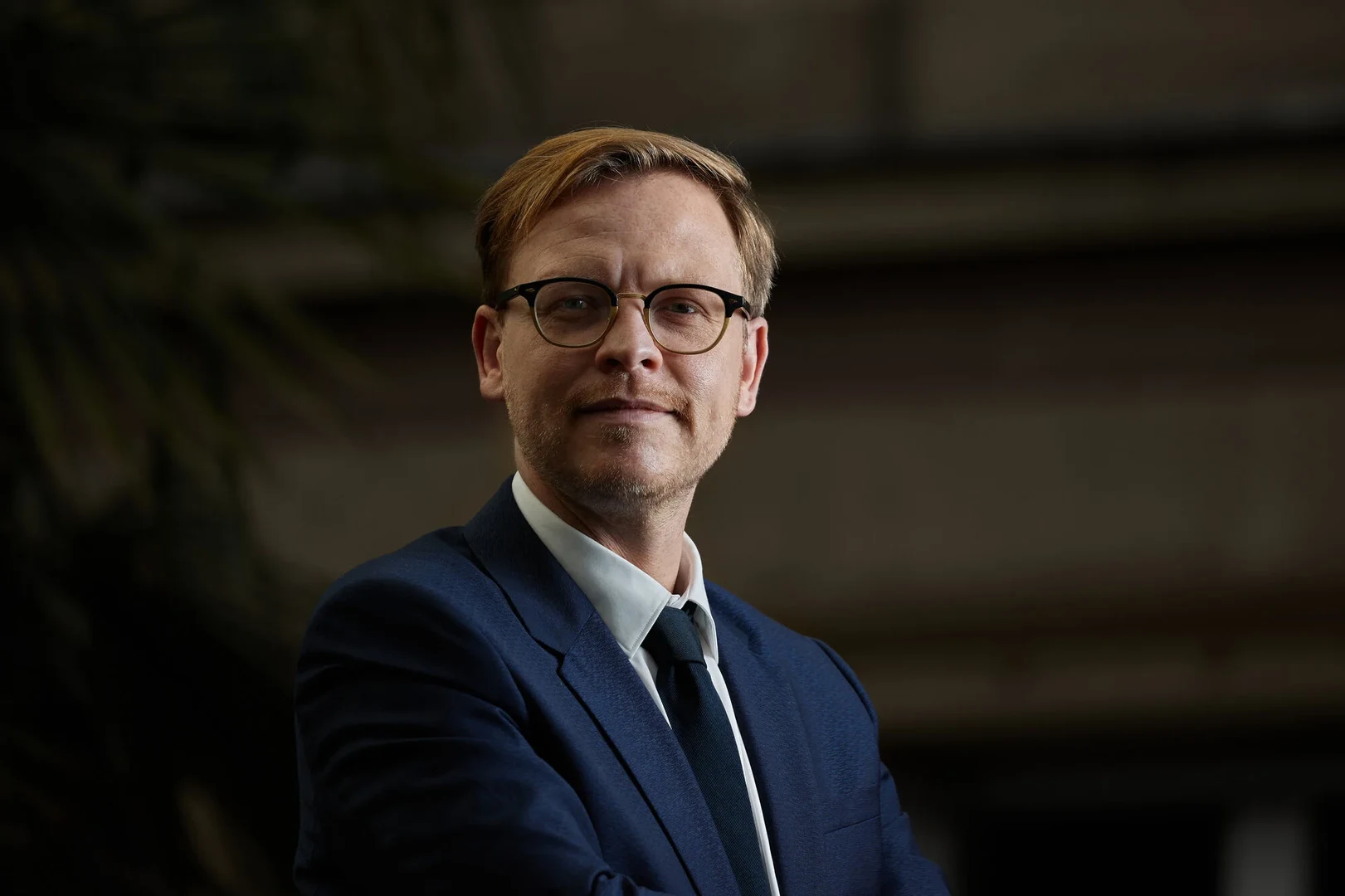 Markus Gabriel. © Volker Lannert / University of Bonn.
Biographical note
Born in Remagen, Rhineland, on April 6, 1980, Markus Gabriel is one of the most prominent figures in contemporary philosophy. He studied Philosophy and Ancient Greek at the Universities of Bonn, Heidelberg, Lisbon, and New York, and in 2009, at only twenty-nine years old, he became Professor of Epistemology, Modern and Contemporary Philosophy at the University of Bonn — the youngest philosophy full professor in Germany. Since then he has directed the Center for Science and Thought and the International Centre for Philosophy NRW.
His work is a rare exercise in philosophical polyglossia: he reads Aristotle and Hegel with the same ease with which he engages Frege, Kripke, Brandom, or Boghossian, dissolving the firm boundary that still separates, in academic imagination, the analytic and continental traditions. He has been a visiting professor at Aarhus, Berkeley, PUC-Rio, and PUC-Porto Alegre, and his writing possesses that rare quality of being both technically demanding and accessible to the uninitiated reader — a facility that earned him, within Germany and beyond, the somewhat disconcerting epithet of philosophy rockstar.
The New Realism: a documented birth
New Realism is one of the rare philosophical movements whose founding can be dated precisely. On June 23, 2011, at lunch at the Al Vinacciolo restaurant in Naples, Gabriel met with Italian philosopher Maurizio Ferraris, a former collaborator of Derrida and a disciple of Vattimo. From that conversation sprang the program that would become known as Neuer Realismus / Nuovo Realismo.
The shared intuition is simple in formulation and demanding in its consequences: after decades of postmodern constructivism — the often uncritical parade of theses claiming that reality is a product of language, power, culture, or conceptual schemes — it became necessary to rehabilitate the notion that there are things that exist independently of us, and that true statements can be made about them. But this must be done without reverting to naive pre-Kantian metaphysical realism, which presumes transparent access to a single, ultimate reality.
New Realism thus articulates, in Gabriel’s voice, two cardinal theses:
- We apprehend things in themselves. There is epistemic access to a reality that is not mere projection or mental construction.
- Things in themselves do not belong to a single domain called “the world.” There is no absolute totality that encompasses everything that exists.
It is in the second thesis that Gabriel’s originality — and provocation — lies.
The provocative thesis: why the world does not exist
The work that projected Gabriel beyond university circles, Warum es die Welt nicht gibt (2013), translated into Portuguese as Porque Não Existe o Mundo (Temas e Debates, 2014), performs a conceptual sleight of hand: by asserting that the world does not exist, Gabriel is not aligning with traditional skepticism, Berkeleyan idealism, or postmodern nihilism. He is, paradoxically, defending that everything else exists — the planet Earth, evolution, toilets, hair loss, dreams, hope, elementary particles, and even “unicorns on the Moon.”
The thesis is therefore perfectly literal: what does not exist is precisely that hyper-totalizing entity we call the world, understood as the domain that would contain absolutely all domains, the object of all objects, the field of all fields. That super-object is, according to Gabriel, a metaphysical chimera.
The argument, in broad strokes
Gabriel’s reasoning can be summarized as follows:
- To exist is to appear in a field of sense. For any x, to exist means to figure in some domain in which x is intelligible according to the rules proper to that domain.
- The world, defined as absolute totality, would have to contain itself as an object among its objects — since, being the totality of what there is, and the world existing, it would be among what there is.
- But for it to contain itself, the world would have to constitute a field of sense in which it appeared — a field that is either the world itself (leading to circularity) or distinct from it (in which case the world would not be the totality).
- Conclusion: the concept of “the world” is ontologically incoherent. There are infinite fields of sense; there is no meta-field that gathers them all.
The consequence is a radical form of ontological pluralism: reality is not one, it is plural, irreducibly fragmented into domains — without this fragmentation implying relativism or anti-realism. Geology, literature, prime numbers, dreams, economics, Middle-earth: each of these domains obeys its own rules of existence, and in each of them true or false statements can be made.
The ontology of fields of sense
In Fields of Sense: A New Realist Ontology (2015), the technical and academic version of the thesis developed in Why the World Does Not Exist, Gabriel formalizes what he calls his Sinnfeldontologie — ontology of fields of sense.
What is a field of sense?
A field of sense (Sinnfeld) is a domain in which something appears, governed by its own rules of individuation, identity, and truth. To exist is always to exist-in:
- Sherlock Holmes exists — not in 221B Baker Street in London, but in the field of sense constituted by Conan Doyle’s novels.
- The number 7 exists in the field of natural numbers.
- My left hand exists in the field of sense of my body, which in turn exists in the field of the Earth’s biosphere.
- Hope exists in the field of psychological states.
Each field is governed by specific conditions of individuation. Confusing the fields is committing what the philosopher calls an ontological category mistake — it is as absurd to ask where the number 7 is physically located as it is to try to count how many atoms sadness weighs.
Distinguishing ontology from metaphysics
One of the most interesting shifts Gabriel makes is the separation between ontology (the study of what it means “to exist”) and metaphysics (the study of the ultimate, total nature of reality). For Gabriel, the former is a legitimate and necessary discipline; the latter — understood as a theory of the whole — is precisely what his project refuses, inheriting in this the Kantian critique of speculative metaphysics.
To be a realist, for me, is not to say that there is a world independent of the mind. It is to say that there is a plurality of fields in which things independent of the mind — and also things dependent on it — can appear and be known.
The controversy with naturalism: I Am Not My Brain
In Ich ist nicht Gehirn (2015), published in Portugal as Eu Não Sou o Meu Cérebro, Gabriel turns his artillery again against what he calls neurocentrism or brainism: the doctrine, now widely spread, that the person reduces to their brain and mental states are fully explainable in neuroscientific terms.
Gabriel’s objection is, fundamentally, an application of the ontology of fields of sense to the mind–body problem: the self, the person, Geist — categories Gabriel unabashedly rehabilitates in dialogue with Hegel and Schelling — belong to fields of sense distinct from the field of neuronal activity. The brain is a necessary condition of consciousness, not consciousness itself. Reducing the former to the latter is, once more, a category mistake — confusing the keyboard with the symphony.
This position is part of a broader critique of scientism (the doctrine that only the natural sciences provide legitimate knowledge of the real) that runs through the philosopher’s work, and continued in volumes such as Der Sinn des Denkens (The Meaning of Thinking, 2018) and Moralischer Fortschritt in dunklen Zeiten (Moral Progress in Dark Times, 2020), the latter a vigorous defense of the existence of universal moral facts — a proposal that also places Gabriel within the register of moral realism.
Constellations: whom does Gabriel dialogue with?
Markus Gabriel’s intellectual genealogy is deliberately hybrid. Rereading his books is to trace a network of affinities, debts, and disputes worth mapping.
Close allies
- Maurizio Ferraris — co-founder of New Realism. Where Gabriel presents himself as an epistemologist of fields of sense, Ferraris claims to be an ontologist of resistance: for him, to exist is to resist — something that asserts itself against thought without needing to have sense.
- Slavoj Žižek — co-author of Mythology, Madness and Laughter: Subjectivity in German Idealism (2009), sharing with Gabriel an interest in German idealism, especially Schelling.
Fellow travelers in contemporary realism
- Quentin Meillassoux — author of Après la finitude (2006), a central figure of Speculative Realism. Gabriel criticizes him, however, for a residual metaphysical aspiration.
- Graham Harman — founder of Object-Oriented Ontology. There is proximity in realist spirit; divergence concerns the existence of a totality.
- Mario De Caro, Mauricio Beuchot, Hilary Putnam, John Searle — fellow contributors to the rehabilitation of realism.
Interlocutors against whom Gabriel positions himself
- Immanuel Kant — Gabriel rejects agnosticism about the thing-in-itself.
- Martin Heidegger — a recurring target, read as the last great thinker of totality.
- Jacques Derrida and postmodern constructivism — for their implicit anti-realism.
- Richard Dawkins and scientistic naturalism — for hypostatizing physics as ontology.
Predecessors to whom Gabriel owes
- F. W. J. Schelling — subject of his doctoral thesis, source of the intuition of a reality that exceeds any system.
- G. W. F. Hegel — especially in the notion of objective spirit.
- Gottlob Frege — the Sinn/Bedeutung (sense/reference) distinction is the terminological source of the fields of sense.
Audiovisual resources
For those who want to hear Gabriel — not only read him — here is a short selection of accessible online appearances:
Lectures and TEDx
- Why the world does not exist | TEDxMünchen (2013) — the talk that popularized the thesis. In English, with characteristic German humor.
- The Nature of Our Values | TEDxBerlinSalon (2017) — on moral realism and universal ethical facts.
- Markus Gabriel — Why The World Does Not Exist (IAI Academy) — complete introductory course at the Institute of Art and Ideas.
- Markus Gabriel — Making Sense of Thinking — lecture.
Interviews
- Interview with Markus Gabriel — III Encuentro de Filosofía Intercultural — Las Palmas. In Spanish.
- Interview — Splijtstof — “When they start singing, I’m out”: long conversation on the genesis of the no-world view.
- Interview — 3:16 AM — Why the World Does Not Exist But Unicorns Do: biographical and systematic overview.
Critical reception
As with any thought that aims at rupture, Gabriel’s New Realism was met with comparable doses of enthusiasm and critique. Praises highlight the reopening, from a continental standpoint, of the debate about existence and the building of bridges between the analytic and continental traditions.
Criticisms focus on three points:
- Indeterminacy of fields of sense — What criteria distinguish a legitimate field from mere fiction? Some argue the notion is so broad it becomes trivial.
- Self-reference — If the world does not exist, in which field of sense does Gabriel make the assertions of his ontology? Might he be implicitly presupposing a totality he denies?
- Fear of regression — For some critics, the strategy recuperates, in new garb, intuitions akin to Husserl’s regional ontologies or Niklas Luhmann’s systems theory.
Far from impoverishing the program, the controversy confirms its centrality. New Realism is now one of the main centers of inquiry in contemporary ontology.
Essential bibliography
By Markus Gabriel (in Portuguese or available in Portugal)
- Porque Não Existe o Mundo. Lisbon: [Temas e Debates]((https://www.temasedebates.pt/produtos/ficha/porque-nao-existe-o-mundo/15745462), 2014.
- Eu Não Sou o Meu Cérebro: Filosofia da Mente para o Século XXI (available in Portuguese and Brazilian translations).
By Markus Gabriel (in English and German)
- Fields of Sense: A New Realist Ontology. Edinburgh University Press, 2015.
- Why the World Does Not Exist. Polity Press, 2015.
- I Am Not a Brain: Philosophy of Mind for the 21st Century. Polity Press, 2017.
- Neo-Existentialism. Polity Press, 2018.
- Moral Progress in Dark Times: Universal Values for the 21st Century. Polity Press, 2022.
- The Power of Art. Polity Press, 2020.
- Mythology, Madness and Laughter: Subjectivity in German Idealism (with Slavoj Žižek). Continuum, 2009.
On Gabriel and New Realism
- Maurizio Ferraris, Manifesto del nuovo realismo (2012) / Manifesto of New Realism, SUNY Press, 2014.
- Maurizio Ferraris, Introduction to New Realism. Polity, 2014.
- Entry New Realism (philosophy) in the English-language Wikipedia.
- Review of Fields of Sense in Notre Dame Philosophical Reviews.